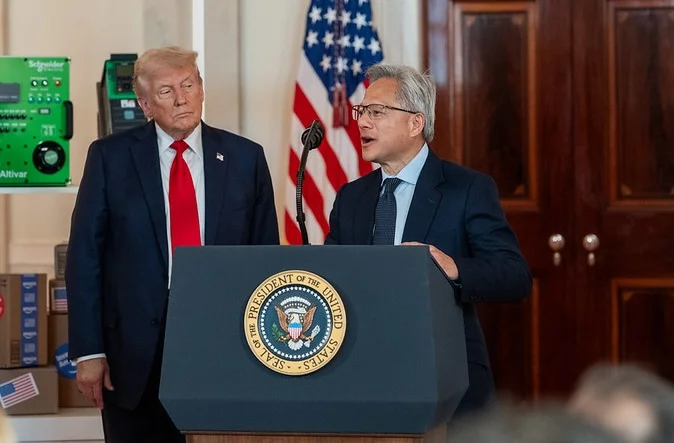
Nvidia CEO Jensen Huang has recently become entangled in a spy scandal. The New York Times reported last Thursday (Oct. 29) that a Chinese national named “Alice Huang” (Huang Le), while serving as a senior executive at Singapore-based “Megaspeed International,” collaborated with Nvidia to build data centers in Asia and is suspected of sharing related information with the Chinese government.
The U.S. government has not yet announced any official findings. U.S. President Donald Trump responded to the matter for the first time last Saturday (the 31st), saying he would “look into it closely,” and described Jensen Huang as a decent person who acts squarely, though the incident involves “very complicated issues.”
Alice Huang’s public résumé and the background of her employer can shed further light on the companies and individuals involved in the case.
According to the Chinese private equity fund database Simuwang, Alice Huang’s title is “fund manager,” and she is listed as executive director of Shanghai Hexi Investment Management. Her public résumé shows she previously worked as a reporter at China’s Hunan TV and CCTV, then served as an assistant to the president at HSBC, and was vice president of the securities business division at CITIC Securities.
However, the New York Post verified this résumé with the relevant institutions. A Hunan TV executive said they did not know Alice Huang, and no records of her as a reporter were found on the Hunan TV or CCTV websites. Shanghai Hexi, HSBC, and CITIC Securities did not respond to inquiries.
Megaspeed, the Singapore chip company where Alice Huang worked, has also drawn attention over the flow of Nvidia chips. Bloomberg reported that as of November 2025, Megaspeed had imported a cumulative 136,000 Nvidia GPUs, but Nvidia inspectors later found only several thousand of the latest chips at the company’s data centers — a discrepancy between the two figures.
The New York Times disclosed that Megaspeed’s parent company is China’s Inspur Group, whose businesses span big data, artificial intelligence (AI), and cloud computing. The U.S. government has already blacklisted Inspur, viewing it as one of the sources for the Chinese People’s Liberation Army’s development of AI technology. The report also noted that Megaspeed has provided computing power to several Chinese companies led by Alibaba.
In addition, according to customs records from trade data platform ImportGenius, from June 2024 to February 2026, Megaspeed purchased US$4.8 billion worth of Nvidia chips and other AI equipment through Malaysian companies.
As early as May this year, U.S. short-selling firm Culper Research published a “China Problem” report and announced it was shorting Nvidia. The report questioned that although Nvidia claims to have exited the Chinese market, more than 20% of its revenue still comes from China, and accused Nvidia of routing GPUs to China through Singapore’s Megaspeed, Apex, Malaysia’s Speedmatrix, and Giga Computing, a subsidiary of Taiwan’s Gigabyte.
After Jensen Huang became embroiled in the Chinese spy scandal, outside attention on Nvidia’s stock price and market value has also intensified. On October 30, Nvidia’s market value fell below US$5 trillion. Jensen Huang’s personal net worth dropped from a peak of US$207 billion in early October to US$177.5 billion — a decline of about US$29.5 billion.
Trump has said he will look closely into the matter. Whether the U.S. side will take further action against Megaspeed and other related companies remains to be seen.
There are suspicions that someone attempted to reach key figures at the heart of the U.S. AI industry through corporate partnerships, but technology security risks are not limited to physical contact. A string of recent cyberattacks worldwide has renewed attention on the security of corporate data and digital assets.
Taiwanese e-commerce service provider 91APP was breached in early October this year, potentially affecting more than 4.79 million consumers, while global cryptocurrency exchange Binance suffered a large-scale asset theft costing approximately US$6.36 billion.
Investigations currently point to North Korea. U.S. blockchain analytics firm TRM Labs said the attack was highly likely orchestrated by the North Korean government-backed hacker group “TraitorTraitor.” On October 29, hackers moved massive assets from multiple Binance digital wallets, with the largest wave of the attack completed in about 20 minutes.
After the incident, Binance urgently contacted other cryptocurrency firms to help track and freeze the stolen assets. About US$2.7 billion to US$3 billion has been successfully intercepted so far, but some assets still flowed into wallets controlled by hackers. Binance said users will not bear the losses — the company will cover compensation.
According to blockchain analytics firm Chainalysis, North Korean hacker groups stole at least US$2.02 billion in cryptocurrency in 2025.
North Korean hackers often use social engineering to gain access inside companies, including studying employees’ social media accounts, posing as recruiters or clients to build connections, and even applying for remote engineer positions to reach corporate systems. After obtaining assets, hackers split funds and transfer them multiple times to frustrate tracing, with some funds laundered gradually over years.
As for the 91APP hack in Taiwan, investigations found the attackers used AI tools to scan the company’s systems for vulnerabilities, then exploited unpatched security gaps to break into internal systems and obtain consumer order data.
The incident may affect nearly 4.8 million consumers, involving brands including PokéYá, adidas, and Cosmed, with 1,329 brands affected. 91APP said passwords, credit card numbers, and other payment information were not affected, but the leaked data includes consumers’ names, phone numbers, delivery addresses, email addresses, and order records. After the personal data leak, the information may be used for subsequent fraud or other illegal purposes, and consumers should watch out for suspicious messages and calls impersonating merchants or logistics companies.